New founders ask this question constantly, and honestly, most advice online overcomplicates it. The LLC vs sole proprietorship debate really comes down to two things — how much risk you’re comfortable carrying personally, and how much paperwork you’re willing to deal with.
Let’s break it down without the legal jargon.
What’s the Real Difference?
Quick answer: a sole proprietorship is you and your business legally treated as one entity, while an LLC (or in India, an equivalent private limited/LLP structure) separates your personal assets from business liabilities. That separation is the whole point of the LLC vs sole proprietorship decision.
Sole Proprietorship: The Simple Route
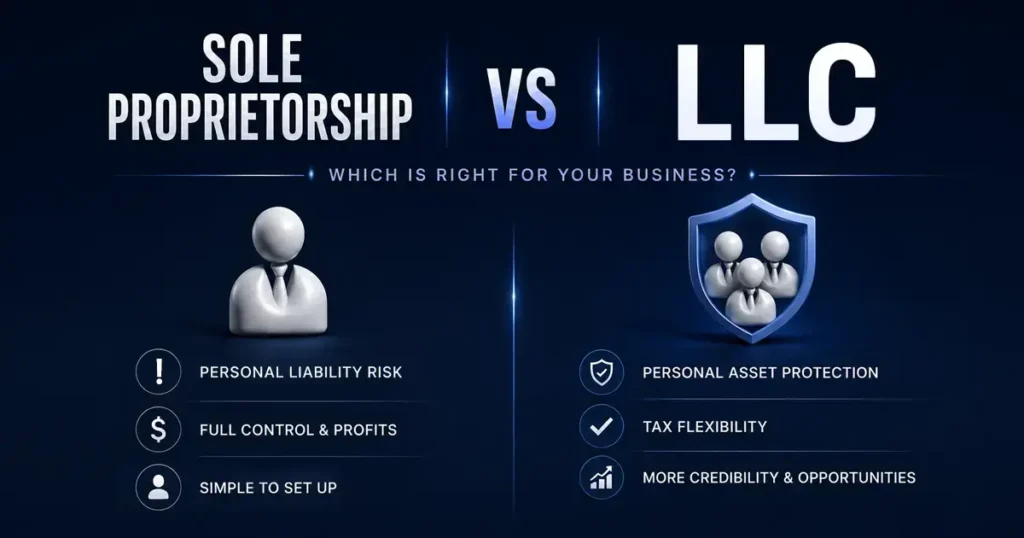
This is where most freelancers and small shop owners start. No separate registration required in many cases, minimal compliance, and you keep full control.
But there’s a catch — if the business runs into debt or gets sued, your personal assets (house, savings, car) aren’t protected. I’ve seen this bite people hard, especially in trading businesses where supplier disputes get messy.
LLC/LLP: The Protective Layer
An LLC structure creates a wall between you and the business. If things go wrong, creditors generally can’t touch your personal bank account or property.
This comes with trade-offs though:
- More paperwork and annual filings
- Higher setup and maintenance cost
- Some administrative overhead you won’t have as a sole proprietor
When Sole Proprietorship Makes More Sense
- You’re testing an idea and not sure it’ll last
- Low financial risk involved (say, a small tutoring business)
- You want to start today without waiting on registration
When an LLC Structure Makes More Sense
- You’re taking on business debt or loans
- You’re bringing in a co-founder or investor
- Your business involves higher liability risk (manufacturing, consulting with contracts, etc.)
Picture two friends starting a small catering business. One structured it as a sole proprietorship because the risk was low and cash flow was tight. The other, running a bigger event management company with vendor contracts worth lakhs, chose an LLP specifically to protect personal assets if a client dispute went to court. Same industry, very different risk exposure.
Tax Differences Worth Knowing
Sole proprietorship income is taxed as your personal income — simple, but it can push you into a higher tax bracket as profits grow. An LLC/LLP structure allows more flexibility in how profits are distributed and taxed, though it needs a proper accountant to manage well. [link to related guide on basic accounting principles here]
Can You Switch Later?
Yes. Plenty of businesses start as sole proprietorships and convert to an LLP or private limited company once revenue and risk grow. It’s not the cleanest process, but it’s fairly common and well-documented by CAs.
FAQ
Is an LLC better than a sole proprietorship for a small side business? Not necessarily. For low-risk side income, sole proprietorship is often simpler and cheaper to maintain.
Does an LLC protect all my personal assets? Mostly, yes — as long as you’re not personally guaranteeing loans or mixing personal and business finances.
How much does it cost to set up an LLC/LLP in India? It varies by state and service provider, but expect professional fees plus government charges, generally a few thousand rupees at minimum.
Can a sole proprietorship have employees? Yes, absolutely. The structure doesn’t limit hiring, just liability protection.
Which is faster to set up? Sole proprietorship, by far. Some businesses start operating the same week.
Conclusion
There’s no universally “right” answer in the LLC vs sole proprietorship debate — it depends on your risk tolerance and growth plans. If you’re just testing waters, keep it simple. If real money and contracts are involved, talk to a chartered accountant before deciding. Don’t let the paperwork scare you out of protecting yourself when it actually matters.