Most startups don’t fail because the idea was bad. They fail because nobody checked if people actually wanted it before building it. Learning how to validate a startup idea properly can save you months of wasted work — and honestly, a fair bit of heartbreak too.
What Does “Validation” Actually Mean?
In simple terms: validating a startup idea means getting real evidence — not opinions from friends — that strangers are willing to pay for your solution before you build the full product.
Friends and family are the worst validators, by the way. They’ll tell you it’s a great idea because they like you, not because they’d actually buy it.
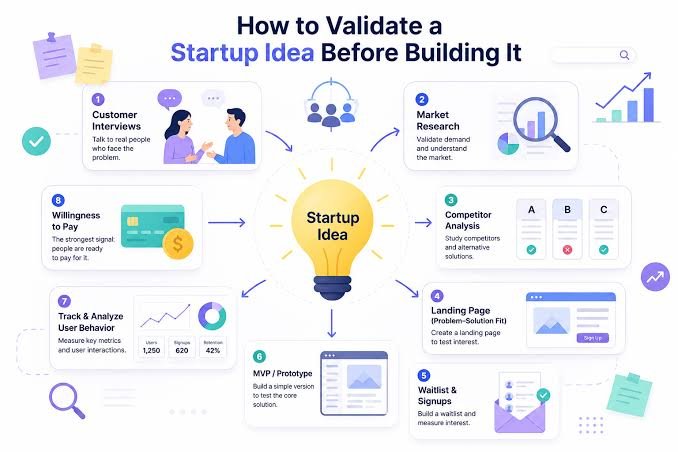
Step 1: Talk to Strangers, Not Friends
Go find 15-20 people who match your target customer and just ask about their problems. Don’t pitch your idea yet. Listen first.
I’ve noticed founders skip this step because it feels slow. It’s not slow — it’s the fastest way to avoid building something nobody needs.
Step 2: Look for the Problem, Not the Solution
A common trap: people fall in love with their solution before confirming the problem is even painful enough. Ask questions like “how are you solving this today?” and “how much time/money does this cost you currently?”
Step 3: Build a Landing Page Before the Product
A single landing page describing your product, with a “Join the Waitlist” or “Pre-order” button, tells you more in a week than months of building ever will.
Picture a founder building a meal-subscription app for working professionals in Bengaluru. Before writing a single line of code, he ran a landing page with ads worth ₹5,000. Forty people signed up in five days. That was enough proof to start building.
Step 4: Run a “Fake Door” Test
This means offering something that doesn’t fully exist yet and measuring interest. If 100 people click “buy” on a product page that isn’t ready, that’s a strong signal. If nobody clicks, you just saved yourself six months.
Step 5: Pre-Sell If You Can
Nothing validates an idea like someone actually paying for it. Even a small deposit from early customers tells you more than a hundred “sounds cool” comments ever will.
Signs Your Idea Needs More Work
- People say “interesting” but don’t ask follow-up questions
- Nobody’s willing to pay even a token amount upfront
- The problem you’re solving isn’t urgent for them
- Competitors exist but customers say they’re “fine” with current options
Signs You’re Onto Something
- People start asking “when can I get this?”
- Some strangers offer to pay before it’s built
- You hear the same complaint repeated by unrelated people
- Existing solutions get complained about often online (check forums, Reddit, X)
FAQ
How long should idea validation take? Anywhere from two to six weeks, depending on how fast you can access your target audience.
Do I need money to validate a startup idea? Not much — a landing page, some small ad spend, and time talking to people is usually enough.
What if nobody responds to my outreach? That itself is useful data. It might mean you’re targeting the wrong audience or the problem isn’t as painful as you assumed.
Should I build an MVP before or after validation? After. An MVP built without validation is just a guess with extra steps.
Is a survey enough to validate an idea? Surveys help but aren’t enough alone — actions (like pre-orders or waitlist signups) are far more reliable than opinions.
Conclusion
Validating a startup idea isn’t glamorous work, but it’s the difference between building something people want and building something that just sits there. Talk to strangers, watch what they actually do — not just what they say — and let real signals guide your next step. [link to related guide on startup funding options here]